
INTRODECTION
The history of the telegram is closely connected with the development of long-distance communication. Before the invention of the telegraph, people depended on slow methods such as messengers, letters carried by horses, ships, or later trains. These methods often took days, weeks, or even months to deliver information. The invention of the telegraph revolutionized communication by allowing messages to be transmitted almost instantly over long distances.
Early Methods of Communication
Before the electric telegraph, humans used many signaling systems to send messages across distances. Ancient civilizations used smoke signals, fire beacons, drum beats, and flag signals. For example, the ancient Greeks used fire signals to announce the fall of Troy. In Africa and Asia, drums were used to transmit coded messages across villages. However, these systems were limited by distance, weather, and the complexity of messages.
In the 18th century, more organized visual telegraph systems were developed. One of the most important was the semaphore system, invented by Claude Chappe in France in the 1790s. It used towers with movable arms to represent letters and words. Messages could be sent across France within hours instead of days. Despite its success, the semaphore system depended on clear weather and daylight, which limited its reliability.
Invention of the Electric Telegraph
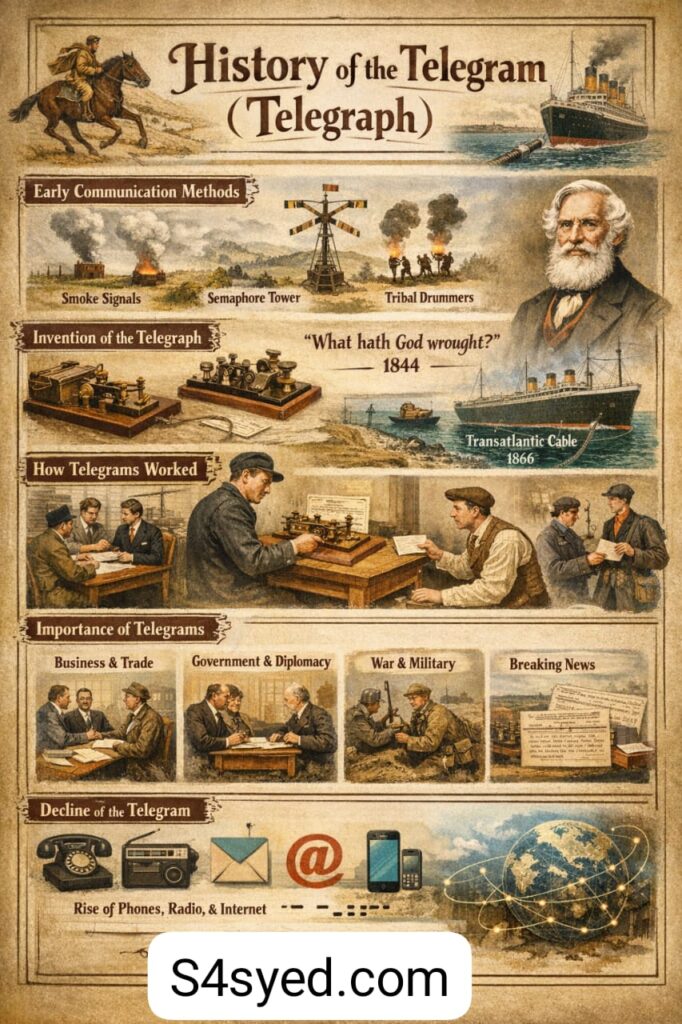
The true breakthrough came with the discovery and practical use of electricity in the 19th century. Scientists realized that electrical signals could travel quickly through wires. Many inventors contributed to early experiments, including William Cooke and Charles Wheatstone in England. However, the most famous name associated with the telegraph is Samuel Morse.
In the 1830s, Samuel Morse, an American inventor and artist, developed a practical electric telegraph system. He also invented Morse code, a system of dots and dashes representing letters and numbers. Morse code made it possible to transmit complex messages efficiently using electrical pulses.
In 1844, the first successful long-distance telegraph message was sent from Washington, D.C., to Baltimore. The message was: “What hath God wrought?” This event marked the beginning of the telegraph era and demonstrated the enormous potential of instant communication.
Spread of Telegraph Networks
After its successful demonstration, telegraph technology spread rapidly across the United States and Europe. Telegraph lines were built alongside railway tracks, which made construction easier and helped railway companies manage train schedules more safely.
By the mid-19th century, telegraph networks connected major cities and towns. Telegraph offices were established where people could send and receive telegrams. A telegram was a written message transmitted electrically and then delivered as a printed or handwritten note to the recipient.
In 1866, a major milestone was achieved with the successful laying of the transatlantic telegraph cable between Europe and North America. This cable allowed messages to be sent across the Atlantic Ocean in minutes instead of weeks. It transformed international diplomacy, trade, and journalism.
How Telegrams Worked
Sending a telegram involved several steps. The sender went to a telegraph office and wrote a message on a form. Because telegrams were charged by the word, messages were usually short and concise. The telegraph operator then translated the message into Morse code and transmitted it over wires.
At the receiving end, another operator decoded the Morse code back into text. The message was then written or printed and delivered to the recipient, often by a messenger. Despite these steps, telegrams were much faster than letters.
Importance of Telegrams
Telegrams played a crucial role in shaping the modern world. They were used in many important areas:
- Business and Trade:
Businesses used telegrams to place orders, confirm transactions, and share market information. This speed improved efficiency and expanded international trade. - Government and Diplomacy:
Governments relied on telegrams for urgent communication. Diplomats used them to negotiate treaties and manage foreign relations. During crises, telegrams allowed leaders to respond quickly. - Journalism:
News agencies such as Reuters and the Associated Press used telegraphs to send breaking news around the world. This led to the rise of modern journalism and global news reporting. - Military Use:
Telegrams were vital during wars. Commanders could send orders and receive updates from the battlefield quickly. During the American Civil War and both World Wars, the telegraph was a key strategic tool. - Personal Communication:
For ordinary people, telegrams were used for important personal messages such as births, deaths, weddings, and emergencies. Receiving a telegram often meant the news was serious or urgent.
Decline of the Telegram
Despite its importance, the telegram began to decline in the 20th century due to new communication technologies. The invention of the telephone allowed people to speak directly to each other, making communication more personal and immediate.
Later, the development of radio, fax machines, email, and finally mobile phones and the internet made telegrams increasingly obsolete. These technologies were faster, cheaper, and more convenient.
By the late 20th century, - many countries had closed their telegram services. In some places, telegrams were maintained for ceremonial or nostalgic reasons, but their practical use had largely disappeared.
Telegram Services in the Modern Era
Although traditional telegram services have mostly ended, their legacy remains strong. Some postal services continued telegram operations into the 21st century before finally shutting them down. For example, India officially ended its telegram service in 2013 after more than 160 years.
Interestingly, the word “Telegram” has gained a new meaning in the digital age due to Telegram Messenger, a modern messaging application. While unrelated to the original telegraph system, the name reflects the same idea of fast and reliable communication.
Legacy of the Telegraph
The invention of the telegraph laid the foundation for all modern communication technologies. It introduced the concept of transmitting information electronically, which later evolved into telephones, computers, and the internet.
Morse code, though rarely used today, is still recognized internationally and is sometimes used in aviation, maritime communication, and amateur radio.
The telegraph also changed how people thought about time and distance. For the first time in history, information could travel faster than people or goods. This helped create a more connected and globalized world.
Conclusion
The history of the telegram is a story of innovation, transformation, and progress. From ancient signal systems to the electric telegraph, humans have always sought faster ways to communicate. The invention of the telegraph in the 19th century revolutionized communication by enabling instant long-distance messaging.
Telegrams played a vital role in business, government, journalism, military operations, and personal communication. Although they have been replaced by modern technologies, their impact on society remains undeniable.
The telegraph was not just a machine; it was a turning point in human history. It connected continents, accelerated decision-making, and paved the way for the digital communication systems we rely on today. In this way, the legacy of the telegram continues to live on in every message sent across the modern world.
