
Introduction
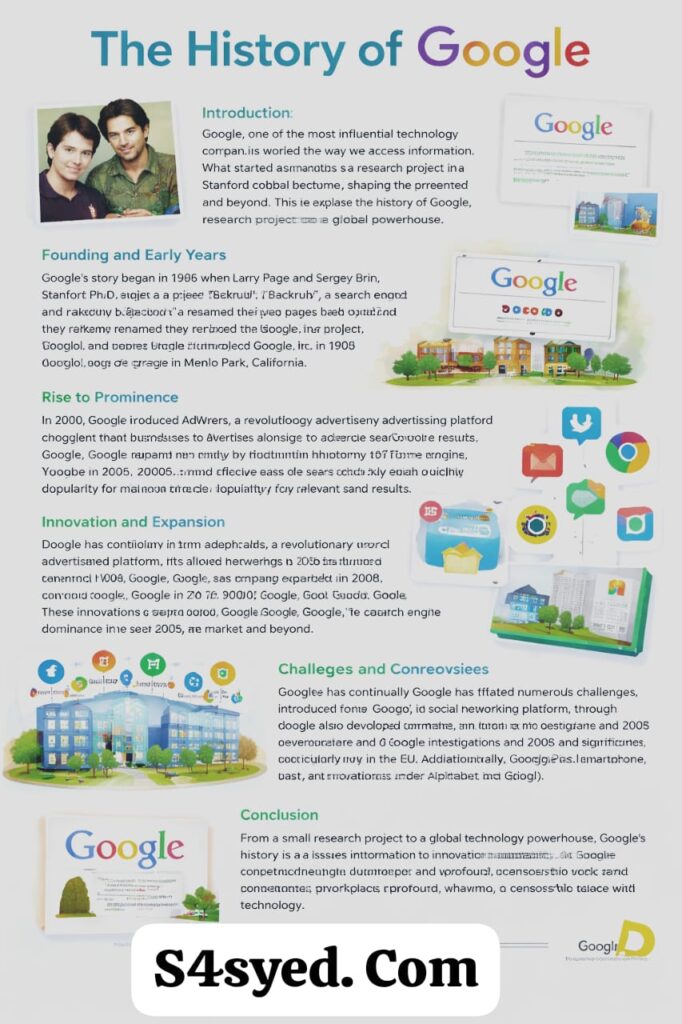
Google is one of the most influential technology companies in the modern world. What began as a small research project by two university students has grown into a global corporation that shapes how people access information, communicate, and do business. Google’s mission, “to organize the world’s information and make it universally accessible and useful,” has guided its development from a simple search engine into a diversified technology giant. This essay explores the history of Google, from its origins in the late 1990s to its rise as a dominant force in the digital age.
Origins at Stanford University Google
The story of Google begins in 1995 at Stanford University, where Larry Page and Sergey Brin met as graduate students in computer science. Both were interested in the problem of searching and organizing information on the rapidly growing World Wide Web. At that time, existing search engines mainly ranked web pages based on how often a search term appeared on a page. This approach often produced inaccurate or low-quality results.
Larry Page developed an idea to rank web pages based on the number and quality of links pointing to them. The idea was inspired by academic citation analysis, where important research papers are cited more frequently. Together, Page and Brin developed an algorithm called PageRank, which measured the importance of web pages by analyzing their links. This innovation formed the foundation of Google’s search technology.
In 1996
In 1996, they created a search engine called BackRub, which ran on Stanford’s servers. BackRub quickly proved more effective than existing search engines, but it also consumed a large amount of bandwidth. Recognizing its potential, Page and Brin decided to turn their research project into a real company.
derived from the mathematical term googol, which represents the number 1 followed by 100 zeros. The name reflected the founders’ ambition to organize an enormous amount of information.
Google was officially founded on September 4, 1998. The company’s first office was a garage in Menlo Park, California, owned by Susan Wojcicki, who later became a key executive at Google. One of the most important early moments in Google’s history was receiving a $100,000 check from Andy Bechtolsheim, a co-founder of Sun Microsystems. This investment helped the company get started.
From the beginning, Google stood out for its clean and simple interface. While other search engines were filled with advertisements and cluttered designs, Google’s homepage focused almost entirely on search. This simplicity, combined with highly relevant search results, quickly attracted users.
Innovation (1999–2003)
As Google’s popularity increased, the company moved to larger offices in Palo Alto and later to Mountain View, California, which became known as the Googleplex. During this period, Google focused on improving its search technology and expanding its infrastructure.
In 2000,
In 2000, Google introduced AdWords, an advertising platform that allowed businesses to display ads alongside search results. Unlike traditional advertising, AdWords targeted users based on their search queries, making ads more relevant and effective. This innovation became Google’s primary source of revenue and played a crucial role in its financial success.
Google also expanded its services beyond basic search. In 2001, Eric Schmidt joined the company as CEO, bringing management experience that complemented the technical skills of Page and Brin. Under his leadership, Google grew rapidly while maintaining its culture of innovation.
(2004–2009)
In 2004, Google launched Gmail, a free email service offering 1 GB of storage, far more than competitors at the time. Gmail’s speed, search capabilities, and innovative features transformed how people used email.
That same year, Google went public through an initial public offering (IPO). The IPO raised significant capital and made Google one of the most valuable technology companies in the world. Despite becoming a public company, Google maintained its informal culture and famous motto, “Don’t be evil,” emphasizing ethical business practices.
Very important point
During this period, Google introduced several important products:
Google Maps (2005), which revolutionized navigation and mapping
Google Earth, offering detailed satellite imagery of the planet
Google Docs and other productivity tools, which later became part of Google Workspace
In 2006, Google acquired YouTube, recognizing the growing importance of online video. This acquisition proved to be one of the most successful in technology history, turning YouTube into the world’s largest video-sharing platform.
The Rise of Android and Mobile Computing
One of Google’s most significant strategic moves was the acquisition of Android Inc. in 2005. Android was an open-source mobile operating system that Google developed to compete in the growing smartphone market.
In 2008,
,
Google released the first Android-powered phone. Android’s open nature allowed manufacturers to adopt and customize it, leading to rapid global adoption. Today, Android is the most widely used mobile operating system in the world.
Google’s focus on mobile technology also influenced its search and advertising businesses, as more users began accessing the internet through smartphones rather than desktop computers.
Under Alphabet (2015)
By the early 2010s, Google had expanded into many areas beyond search and advertising, including artificial intelligence, self-driving cars, cloud computing, and hardware. To manage this growing complexity, Google announced a major corporate restructuring in 2015.
A new parent company called Alphabet Inc. was created. Google became a subsidiary of Alphabet, focusing primarily on internet-related products such as search, advertising, YouTube, and Android. Other experimental and long-term projects, such as Waymo (self-driving cars) and Verily (life sciences), were placed under Alphabet.
This restructuring allowed greater transparency and flexibility, enabling different divisions to innovate more effectively.
Google in the Era of Artificial Intelligence
Artificial intelligence (AI) has become a central focus of Google’s strategy. The company has invested heavily in machine learning, natural language processing, and data analytics. Google Assistant, Google Translate, and improvements in search accuracy all rely on AI technologies.
In 2016
Google’s AI system AlphaGo defeated a world champion in the complex board game Go, demonstrating the power of advanced machine learning. This achievement marked a major milestone in AI research.
Google continues to integrate AI into its products, improving personalization, efficiency, and user experience.
Challenges and Controversies
Despite its success, Google has faced numerous challenges and controversies. Issues related to data privacy, market dominance, misinformation, and ethical use of technology have drawn criticism from governments and the public.
Regulatory authorities in several countries have investigated Google for anti-competitive practices. In response, the company has made changes to its policies and emphasized transparency and responsibility.
Balancing innovation with ethical considerations remains one of Google’s biggest challenges.
Conclusion
From a university research project to a global technology leader, Google’s journey is a remarkable story of innovation, vision, and impact. Its search engine transformed how people access information, while its products and services have become deeply integrated into daily life.
Google’s history reflects the rapid evolution of the internet and digital technology. As the company continues to invest in artificial intelligence, cloud computing, and emerging technologies, it is likely to remain a central force in shaping the future of the digital world.
.
