
INTRODECTION
Canva is one of the most influential digital design platforms in the modern world. Founded in Australia, Canva transformed graphic design from a skill reserved for professionals into an accessible activity for anyone with an internet connection. Its history is closely tied to the rise of cloud computing, social media, and the growing demand for visual communication. This essay explores the origins of Canva, its development, major milestones, challenges, and its global impact on design and education.
Origins and Founding (2012)
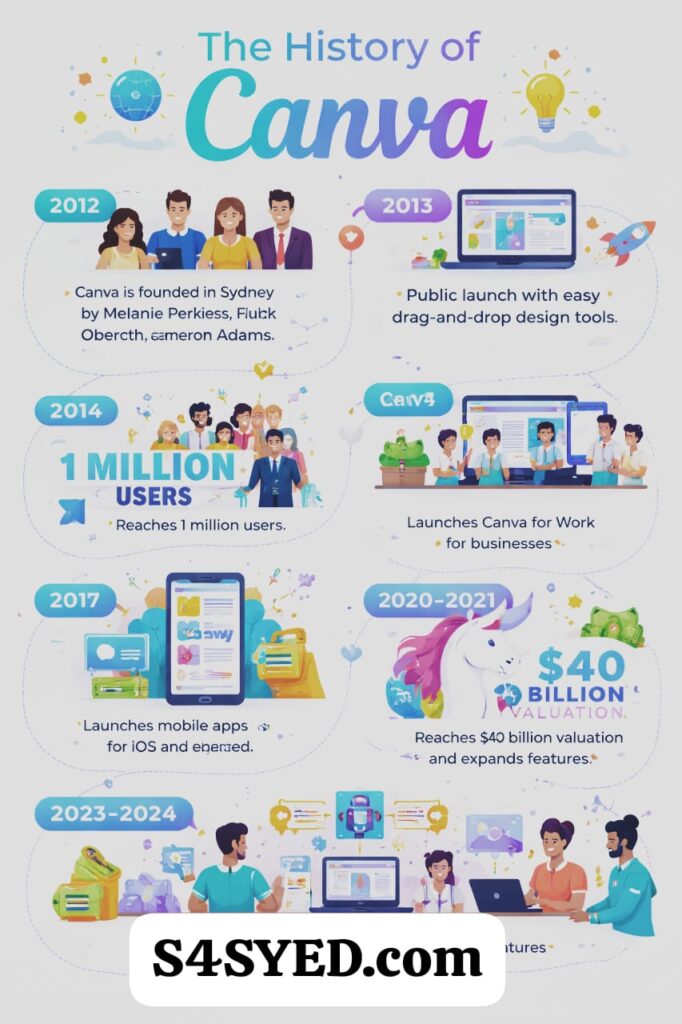
Canva was founded in 2012 by Melanie Perkins, Cliff Obrecht, and Cameron Adams in Sydney, Australia. The idea for Canva originated several years earlier when Melanie Perkins was teaching fellow university students how to use professional design software such as Adobe Photoshop and InDesign. She noticed that many students found these tools complicated, time-consuming, and intimidating. This experience led her to question why design software could not be simpler and more intuitive.
Before Canva, Perkins and Obrecht launched a company called Fusion Books, an online platform that allowed schools to design and print yearbooks. Fusion Books used drag-and-drop tools, making it easier for non-designers to create professional layouts. The success of Fusion Books proved that there was a strong demand for easy-to-use design software and laid the foundation for Canva.
Cameron Adams, a former Google designer, joined as a co-founder and brought valuable technical and design expertise. Together, the three founders envisioned a platform that would democratize design by allowing anyone—regardless of skill level—to create high-quality visual content.
Early Development and Challenges
Developing Canva was not easy. In its early days, the founders faced significant challenges in securing funding and gaining investor confidence. Many investors were skeptical of the idea that professional design could be simplified for the general public. Additionally, competing against established companies like Adobe seemed unrealistic to many.
Despite these obstacles, the Canva team persisted. They focused on building a product that emphasized simplicity, accessibility, and collaboration. The platform was cloud-based, meaning users did not need to install software. Designs could be created directly in a web browser, making Canva highly accessible.
After numerous rejections, Canva secured seed funding from prominent investors, including technology entrepreneur Bill Tai and venture capital firm Matrix Partners. This funding enabled the company to officially launch Canva to the public in 2013.
Public Launch and Early Growth (2013–2015
Canva was publicly launched in 2013, and it quickly gained attention for its user-friendly interface. The platform offered pre-designed templates for social media posts, presentations, posters, invitations, and more. Users could customize these templates using drag-and-drop tools, fonts, icons, and images.
One of Canva’s key innovations was its freemium business model. Users could access many tools and templates for free, while premium features and images were available through paid subscriptions. This approach allowed Canva to attract millions of users while generating revenue.
By 2014, Canva had more than one million users, and its popularity continued to grow rapidly. The platform became especially popular among small business owners, students, teachers, and social media creators who needed professional-looking designs without hiring graphic designers.
Expansion of Features and Services
As Canva’s user base grew, the company expanded its features to meet diverse needs. It introduced tools for presentations, resumes, infographics, marketing materials, and video content. Canva also added collaboration features, allowing teams to work together on designs in real time.
A major milestone was the launch of Canva for Work (later renamed Canva Teams), which targeted businesses and organizations. This version included brand kits, shared folders, and advanced collaboration tools, making Canva suitable for professional environments.
Another important development was the creation of Canva for Education and Canva for Nonprofits. These initiatives provided free premium access to eligible schools, teachers, students, and nonprofit organizations. This decision strengthened Canva’s presence in education and reinforced its mission to empower people through design.
Mobile Apps and Global Reach
Recognizing the growing importance of mobile technology, Canva launched mobile applications for iOS and Android. These apps allowed users to design on smartphones and tablets, further increasing accessibility. Mobile design was particularly important for social media content creators who needed quick and convenient tools.
Canva’s global expansion was rapid. The platform became available in multiple languages and attracted users from over 190 countries. By the late 2010s, Canva had offices in several major cities, including Sydney, San Francisco, Manila, and Beijing.
The company’s global success was driven by its understanding of local markets and its ability to adapt to different cultural and professional needs. Canva’s design templates often reflected regional trends,
Competition and Innovation
As Canva grew, it faced increasing competition from both traditional design software companies and new startups. Adobe, in particular, responded by improving usability and introducing cloud-based tools. However, Canva maintained its competitive advantage by focusing on ease of use rather than professional complexity.
Innovation remained central to Canva’s strategy. The company invested heavily in artificial intelligence and automation. Features such as Magic Resize, background remover, and design suggestions used AI to save time and improve user experience.
Canva also built an extensive content marketplace, allowing designers and photographers to sell templates, illustrations, and images. This ecosystem benefited both creators and users, strengthening Canva’s platform.
Valuation and Major Milestones (2020–2022)
During the COVID-19 pandemic, Canva experienced significant growth. With more people working, studying, and communicating online, the demand for digital design tools increased dramatically. Canva became a vital resource for remote learning, online marketing, and virtual events.
By 2021, Canva reached a valuation of over $40 billion, making it one of the most valuable private technology companies in the world. The platform had hundreds of millions of users and billions of designs created.
Canva also made strategic acquisitions to enhance its capabilities. These included companies specializing in photo editing, animation, and content libraries. Such acquisitions allowed Canva to expand beyond static design into video and interactive content.
Canva’s Mission and Corporate Culture
gn.” This mission reflects the company’s belief that design should not be limited to professionals. Canva’s founders emphasized positive company culture, inclusivity, and social responsibility.
The company is known for its commitment to philanthropy. Canva pledged to donate a significant portion of its equity to charitable causes, focusing on education, poverty alleviation, and social impact. This approach distinguishes Canva from many other technology companies.
Impact on Education and Business
Canva has had a profound impact on education. Teachers use Canva to create engaging learning materials, while students use it for presentations and assignments. The platform encourages creativity and visual literacy, skills that are increasingly important in the digital age.
In business, Canva has enabled startups and small enterprises to compete visually with larger companies. Marketing materials, logos, and social media graphics can be created quickly and affordably, reducing barriers to entry.
Canva has also influenced the broader design industry by changing expectations around usability. Many software companies now prioritize user experience and simplicity, reflecting Canva’s influence.
Recent Developments and the Future of Canva
In recent years, Canva has focused on integrating artificial intelligence, generative design, and advanced collaboration tools. Features that automatically generate layouts, text, and images demonstrate Canva’s commitment to innovation.
Looking ahead, Canva aims to become a complete visual communication platform rather than just a design tool. Its future likely includes deeper AI integration, expanded video and interactive content tools, and continued global growth.
Conclusion
The history of Canva is a story of innovation, persistence, and democratization. From its humble beginnings in an Australian classroom to becoming a global design powerhouse, Canva has fundamentally changed how people create and communicate visually. By prioritizing simplicity, accessibility, and user empowerment, Canva has made design available to millions who previously lacked the skills or resources.
Canva’s journey illustrates how technology can break down barriers and create opportunities on a global scale. As visual communication continues to grow in importance, Canva’s influence on education, business, and creativity is likely to remain strong for years to come.
