
INTRODECTION
The International Mathematical Olympiad (IMO) is the world’s most prestigious mathematics competition for high school students. Since its inception in the mid-twentieth century. The IMO has played a vital role in identifying young mathematical talent, promoting international cooperation, and encouraging the study of mathematics at an advanced level. Over the decades, the IMO has grown from a small regional contest into a truly global academic event, involving over one hundred countries and thousands of participants. The history of the IMO reflects not only the development of mathematical education but also the broader political, cultural, and scientific changes of the modern world.
Origins and Background
The roots of the International Mathematical Olympiad can be traced back to Eastern Europe.Where mathematical competitions were already well established in the early twentieth century. Countries such as Hungary, Romania, and the Soviet Union had a strong tradition of organizing national mathematics Olympiads to encourage talented students and strengthen scientific education. These competitions were seen as an effective way to nurture problem-solving skills, creativity, and logical thinking among young learners.
After World War II
, there was a renewed emphasis on education and scientific development, especially in socialist countries. Mathematics, being a foundational discipline for science and technology, received particular attention. In this context, the idea of an international mathematics competition for secondary school students began to take shape. Educators and mathematicians believed that such an event could foster intellectual exchange, peaceful cooperation, and mutual understanding among young people from different nations.
The First International Mathematical (1959)
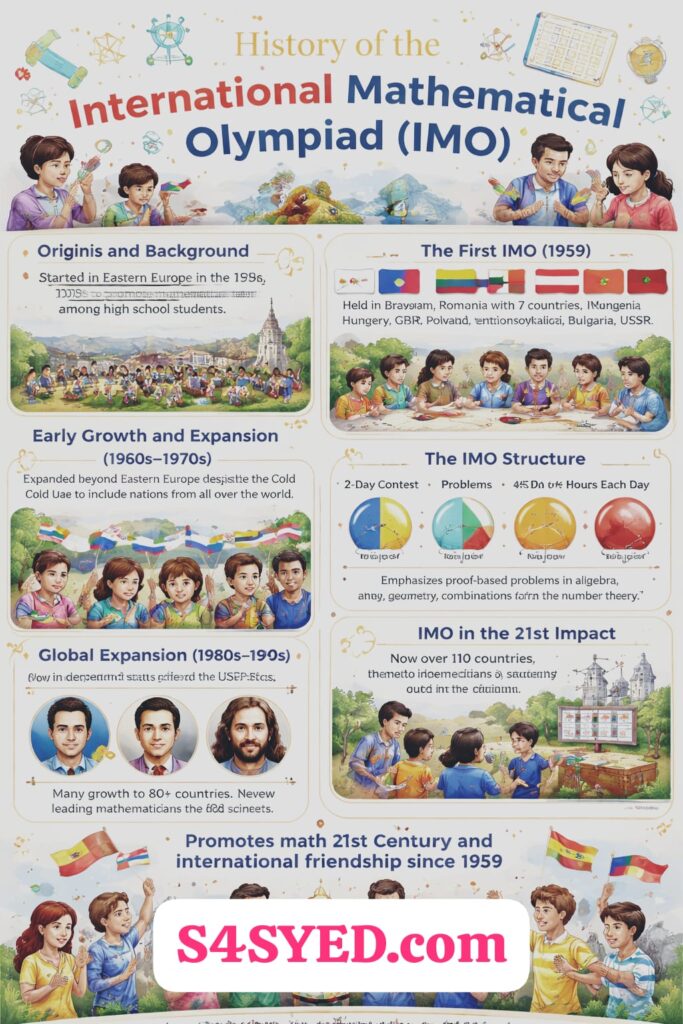
The first International Mathematical Olympiad was held in 1959 in Brașov, Romania. It was organized by Romania and participated in by only seven countries: Romania, Hungary, the German Democratic Republic (East Germany), Poland, Czechoslovakia, Bulgaria, and the Soviet Union. A total of 52 students took part in this historic event.
The competition consisted of six challenging problems, designed to test deep understanding rather than routine calculation. The success of the first IMO exceeded expectations. Participants and leaders recognized the value of the event, not only as a competition but also as a forum for cultural exchange and academic inspiration. As a result, it was agreed that the Olympiad should be held annually.
Early Growth and Expansion (1960s–1970s)
During the 1960s, the IMO gradually expanded beyond Eastern Europe. More countries from both socialist and non-socialist blocs began to participate, despite the political tensions of the Cold War. This was remarkable, as the IMO became one of the few platforms where students from rival political systems could meet peacefully and collaborate intellectually.
By the late 1960s, countries from Western Europe, Asia, and the Americas had joined the Olympiad. Japan first participated in 1967, followed by the United States in 1974. This period marked the transformation of the IMO from a regional event into a truly international competition.
The structure of the competition also became more standardized. Each participating country was allowed to send a team of up to six students, accompanied by a team leader and deputy leader. The problems were selected by an international jury, ensuring fairness and high mathematical quality.
Structure and Nature of the Competition
The IMO is held over two consecutive days, with students solving three problems per day, each lasting 4.5 hours. The problems are typically drawn from areas such as algebra, geometry, number theory, and combinatorics. Calculus and higher mathematics are generally excluded, emphasizing creativity and ingenuity rather than advanced formal knowledge.
Each problem is worth 7 points, making a total possible score of 42 points. Medals are awarded based on relative performance: gold, silver, and bronze medals, along with honorable mentions. The approximate ratio of medals is carefully maintained to ensure consistency across years.
What distinguishes the IMO from many other competitions is its emphasis on proof-based solutions. Students must present clear, logical, and rigorous arguments, demonstrating not only that they know the answer but also why it is correct.
The IMO During the Cold War
The Cold War era significantly influenced the development of the IMO. Many participating countries viewed success at the Olympiad as a symbol of educational and scientific strength. As a result, extensive training programs were developed, especially in the Soviet Union and Eastern Europe. These programs produced generations of exceptionally strong problem solvers.
Despite political rivalries, the IMO remained a space of cooperation and mutual respect. Students and leaders interacted freely, shared ideas, and formed friendships that often lasted a lifetime. Mathematics served as a universal language, transcending ideological boundaries.
Inclusion of More Countries (1980s–1990s)
The 1980s and 1990s witnessed rapid growth in participation. Countries from Africa, the Middle East, Southeast Asia, and Latin America increasingly joined the Olympiad. By the end of the twentieth century, over 80 countries were regularly participating.
The fall of the Soviet Union in 1991 led to the emergence of several new independent states, many of which began competing separately in the IMO. This further increased the number of participating nations and diversified the mathematical community.
During this period, the IMO also benefited from improved communication and transportation, making international collaboration easier. Host countries invested significant resources to organize the event, often showcasing their cultural heritage alongside the competition.
Notable Participants and Impact
Many former IMO participants have gone on to become leading mathematicians, scientists, and innovators. Several Fields Medalists—the highest honor in mathematics—were former IMO medalists. Examples include Terence Tao, Grigori Perelman, and Maryam Mirzakhani.
However, the impact of the IMO extends beyond producing elite mathematicians. Participants often develop strong analytical skills, discipline, and confidence, which benefit them in various careers such as engineering, computer science, economics, and finance. The Olympiad experience also fosters international understanding and lifelong friendships.
IMO in the 21st Century
In the 21st century, the IMO has continued to grow in scale and significance. Today, more than 110 countries participate annually, making it one of the largest and most inclusive academic competitions in the world. Advances in technology have improved problem coordination, translation, and marking processes.
COVID-19
A notable moment in recent history was the 2020 and 2021 IMOs, which were held in a remote format due to the COVID-19 pandemic. Despite the challenges, the organizers successfully adapted, demonstrating the resilience and importance of the Olympiad. These events marked the first time in history that the IMO was conducted largely online.
Role in Global Mathematics Education
The IMO has inspired the creation of numerous national and regional mathematics competitions, such as the Asian Pacific Mathematical Olympiad (APMO), the European Girls’ Mathematical Olympiad (EGMO), and various national Olympiads worldwide. These competitions serve as stepping stones for students aspiring to reach the IMO level.
Moreover, the IMO has influenced mathematics education by emphasizing problem solving, creativity, and deep understanding. Many educators incorporate Olympiad-style problems into curricula to challenge students and promote higher-order thinking.
Challenges and Criticism
Despite its success, the IMO has faced some criticism. Some argue that the intense training required favors students from countries with strong educational resources, potentially disadvantaging those from less developed regions. Others worry that excessive focus on competition may create unhealthy pressure on students.
In response, efforts have been made to promote inclusivity and support developing countries through training programs, outreach initiatives, and regional Olympiads. The creation of EGMO has also helped address gender imbalance by encouraging more female participation in high-level mathematics competitions.
Conclusion
The International Mathematical Olympiad has come a long way since its modest beginnings in Romania in 1959. From a small gathering of seven countries, it has evolved into a global celebration of mathematical talent and intellectual curiosity. Throughout its history, the IMO has demonstrated the power of mathematics to unite people across cultures, languages, and political systems.
By challenging young minds and fostering international cooperation, the IMO continues to play a crucial role in shaping the future of mathematics and science. Its legacy lies not only in medals and rankings but also in the countless students inspired to pursue knowledge, creativity, and excellence. As the world becomes increasingly interconnected, the International Mathematical Olympiad stands as a symbol of how education and intellectual pursuit can bring humanity together.
