
introdection
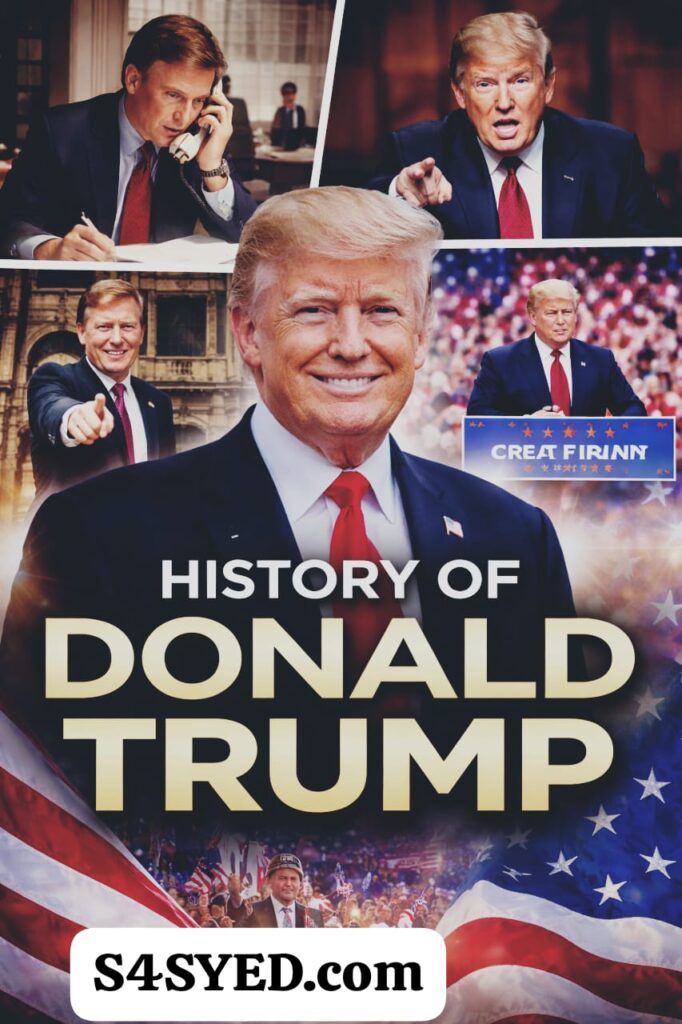
Donald John Trump is one of the most well-known and controversial figures in modern American history. He is a businessman, television personality, and politician who served as the 45th President of the United States. His life story includes success in real estate,
fame through media, and a dramatic rise in politics that changed the tone of American public life. This essay explores the history of Donald Trump from his early life to his business career, media presence, presidency, and lasting impact.
Early Life and Family Background
Donald John Trump was born on June 14, 1946, in Queens, New York City. He was the fourth of five children born to Fred Trump and Mary Anne MacLeod Trump. His father
, Fred Trump, was a successful real estate developer who built and managed middle-class housing in New York. His mother was an immigrant from Scotland who played a strong role in shaping the family’s values.
Donald Trump grew up in a wealthy household but was known to be energetic and rebellious as a child. Due to behavioral issues, his parents sent him to the New York Military Academy at the age of 13. The military-style discipline had a strong influence on his personality, teaching him leadership, competitiveness, and strict structure.
Trump later attended Fordham University before transferring to the Wharton School of the University of Pennsylvania, one of the top business schools in the United States. He graduated in 1968 with a degree in economics.
Early Business Career
After completing his education, Donald Trump joined his father’s real estate business. At first, he worked on housing projects in Brooklyn and Queens, focusing on affordable housing. However, Trump had much bigger ambitions. He wanted to make his mark in Manhattan, the center of luxury real estate and business power.
In the 1970s
, Trump began developing large projects in New York City. One of his earliest major successes was the renovation of the Commodore Hotel, which later became the Grand Hyatt New York. This project helped establish Trump as a serious businessman and gave him access to powerful investors and banks.
Trump’s business strategy focused on bold branding, luxury, and publicity. He placed his name on buildings, casinos, hotels, and products, turning “Trump” into a global brand.
Rise of the Trump Brand
During the 1980s
, Donald Trump became a symbol of wealth and success in America. He developed Trump Tower on Fifth Avenue in New York City, which became his most famous property. The tower represented luxury, power, and ambition, perfectly matching Trump’s public image.
Trump expanded his business empire into casinos in Atlantic City, hotels, golf courses, and international real estate. He also wrote books, most notably The Art of the Dea
l, which became a bestseller and strengthened his reputation as a master negotiator.
However, Trump’s business career was not without failure. In the 1990s, several of his casinos and businesses went bankrupt.
He faced massive debt and criticism. Despite these setbacks, Trump managed to rebuild his image and finances through restructuring, licensing deals, and media exposure.
Television and Media Fame
A major turning point in Trump’s public life came in 2004 with the launch of the reality television show The Apprentice. On the show, Trump played the role of a powerful boss, judging contestants in business challenges and famously saying, “You’re fired.”
The show was extremely successful and made Trump a household name across the United States and around the world. It introduced him to millions of people who had little knowledge of his real estate background. Through television,
Trump rebuilt his image as a strong, decisive, and wealthy leader.
Media exposure became a key part of Trump’s influence. He regularly appeared in interviews, talk shows, and news headlines. His communication style was direct, bold, and often controversial, which attracted constant attention.
Entry into Politics
Donald Trump had expressed interest in politics for many years before officially entering the field. He considered running for president multiple times but did not do so until 2015.
In June 2015, Trump announced his candidacy for President of the United States as a Republican. His campaign surprised political experts. He was not a traditional politician and openly criticized both major political parties, the media, and government institutions.
Trump’s campaign focused on themes such as:
“America First”
Strong borders and immigration control
Economic nationalism
Criticism of global trade deals
Opposition to political elites
His blunt language and unfiltered style appealed to many voters who felt ignored by traditional politicians. At the same time, his statements were often criticized as divisive and offensive.
2016 Presidential Election
The 2016 U.S. presidential election was one of the most dramatic in history. Trump faced several experienced Republican candidates during the primary elections but defeated them through strong voter support and media dominance.
In the general election,
Trump ran against Democratic candidate Hillary Clinton. Most polls and experts predicted Clinton would win. However, Trump won key swing states and secured victory in the Electoral College, becoming the 45th President of the United States.
His victory shocked the world and marked a major shift in American politics. Trump became the first president with no prior political or military experience.
Presidency (2017–2021)
Donald Trump was inaugurated as president on January 20, 2017. His presidency was marked by bold decisions, controversy, and strong political division.
Domestic Policies
Trump focused on tax cuts, deregulation, and boosting American industries. One of his major achievements was the Tax Cuts and Jobs Act of 2017, which reduced corporate and individual taxes.
He appointed conservative judges to federal courts, including three Supreme Court justices, which had a long-term impact on U.S. law.
Immigration
Immigration was one of Trump’s most debated issues. He supported strict border control and called for building a wall along the U.S.-Mexico border
. His administration introduced travel restrictions on several countries, which led to legal challenges and public protests.
Foreign Policy
Trump followed an “America First” foreign policy. He renegotiated trade agreements, withdrew from some international deals, and increased pressure on countries like China and Iran.
At the same time, he became the first U.S.
president to meet a North Korean leader, aiming to reduce tensions.
Controversies and Impeachments
Trump’s presidency was filled with controversy. He frequently criticized the media, calling it biased. His use of social media, especially Twitter, changed how presidents communicated with the public.
Trump was impeached twice by the House of Representatives. The first impeachment was related to Ukraine, and the second followed the January 6, 2021 Capitol riot. In both cases, he was acquitted by the Senate.
2020 Election and Aftermath
In the 2020 election, Trump ran for re-election against Democrat Joe Biden. Due to the COVID-19 pandemic, the election included widespread mail-in voting.
Biden won the election, but Trump refused to accept the results, claiming election fraud without sufficient evidence. This led to legal challenges and public tension.
On January 6, 2021, a group of Trump supporters stormed the U.S. Capitol. The event shocked the nation and the world. Trump’s role and statements during this period remain heavily debated.
Trump left office on January 20, 2021, but remained a powerful figure in American politics.
Life After Presidency and Legacy
After leaving the White House, Donald Trump continued to influence the Republican Party. He remained active in rallies, endorsements, and media appearances.
Trump’s legacy is complex and
deeply divided. Supporters see him as a leader who challenged elites, strengthened the economy, and put America first. Critics view him as a divisive figure who weakened democratic norms and increased political polarization.
Regardless of opinion, Donald Trump has left a lasting mark on U.S. politics, media, and global discussions about leadership and power.
Conclusion
The history of Donald Trump is a story of ambition, controversy, success, and conflict. From a wealthy New York upbringing to global fame, from business triumphs and failures to the highest political office, Trump’s journey is unlike any other in American history.
He changed how politics is communicated, challenged traditional systems, and reshaped political debate. Whether admired or criticized, Donald Trump remains one of the most influential figures of the 21st century.
