
Facebook: A Complete and Detailed Guide
Introduction plateform.
Facebook is one of the world’s largest and most influential social media platforms. Since its launch in 2004, Facebook has transformed how people communicate, share information, do business, and stay connected with the world. With billions of active users, Facebook is no longer just a social networking site—it is a powerful digital ecosystem that includes messaging, advertising, video content, online communities, and business tools.
This article provides a complete overview of Facebook, including its history, features, benefits, uses, business opportunities, privacy, advantages, disadvantages, and future scope.
History of Facebook
founder
Facebook was founded in February 2004 by Mark Zuckerberg, along with his college roommates Eduardo Saverin, Andrew McCollum, Dustin Moskovitz, and Chris Hughes. Initially, it was created as a social network exclusively for Harvard University students. Due to its popularity, it quickly expanded to other universities, then high schools, and eventually the general public.
In 2006, Facebook opened registration to anyone aged 13 and older with a valid email address. Over time, it added many new features such as News Feed, Pages, Groups, Messenger, Marketplace, Live Video, and Stories.
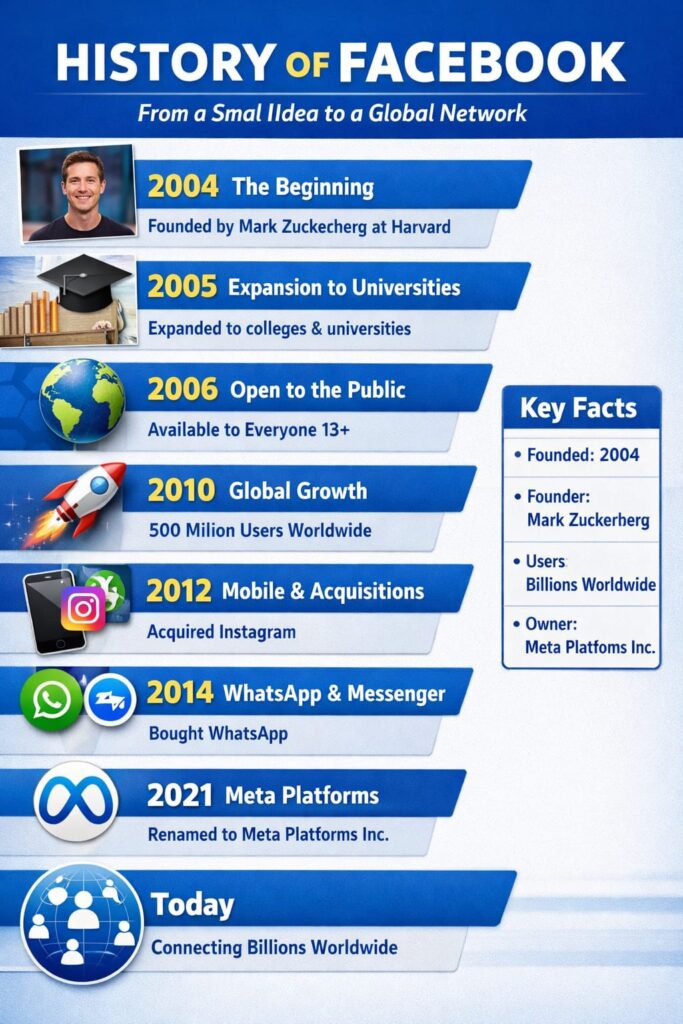
In 2021, Facebook’s parent company was renamed Meta Platforms Inc., reflecting its vision to build the “metaverse,” a digital virtual world. However, Facebook remains the core platform under Meta.
What Is Facebook?
facilities
Facebook is a social networking platform that allows users to:
Create personal profiles
Connect with friends and family
Share text posts, photos, videos, and links
React, comment, and share content
Join groups and communities
Follow public figures, brands, and organizations
Facebook is available through web browsers and mobile applications on Android and iOS devices.
Facebook User Profile
A Facebook profile is a personal space where users share information about themselves. A typical profile includes:
Name and profile picture
Cover photo
Bio and personal details
Education and workplace
Friend list
Timeline of posts and activities
Users can control who sees their information using privacy settings.
Facebook Friends and Connections
Facebook allows users to send and receive friend requests. Once accepted, users become friends and can see each other’s posts (depending on privacy settings).
Users can also:
Follow people without being friends
Unfriend or block users
Create custom friend lists
News Feed
The News Feed is the main page users see when they log in. It shows posts from friends, pages, groups, and advertisers. Facebook uses a complex algorithm to decide what content appears in the feed based on:
User interests
Engagement (likes, comments, shares)
Post type (video, image, text)
Recency
Facebook Pages
Facebook Pages are designed for businesses, brands, celebrities, organizations, and public figures. Unlike personal profiles, Pages:
Can have unlimited followers
Are publicly visible
Offer analytics through Facebook Insights
Support advertising and promotions
Pages are widely used for marketing, customer support, and brand awareness.
Facebook Groups
Facebook Groups are communities built around shared interests. Groups can be:
Public (anyone can join)
Private (approval required)
Hidden (invite-only)
Groups are used for education, business networking, hobbies, support communities, and local discussions.
Facebook Messenger
Facebook Messenger is a standalone messaging app that allows users to:
Send text messages
Make voice and video calls
Share photos, videos, and files
Create group chats
Use chatbots for businesses
Messenger is widely used for personal and professional communication.
Facebook Stories
Facebook Stories are short photos or videos that disappear after 24 hours. They appear at the top of the News Feed and are used for:
Daily updates
Promotions
Behind-the-scenes content
Personal moments
Stories are popular due to their temporary and engaging nature.
Facebook Live
Facebook Live allows users and businesses to broadcast live video to their audience. It is commonly used for:
Events
Product launches
Religious programs
Q&A sessions
Educational content
Live videos often receive higher engagement than regular posts.
Facebook Marketplace
Facebook Marketplace is a feature that allows users to buy and sell products locally. Users can list items such as:
Electronics
Vehicles
Furniture
Clothing
Property rentals
It has become a popular alternative to classified websites.
Facebook for Business
Facebook is one of the most powerful platforms for digital marketing. Businesses use Facebook to:
Create brand pages
Run targeted advertisements
Communicate with customers
Generate leads and sales
Facebook Ads
Facebook Ads allow advertisers to target users based on:
Age
Gender
Location
Interests
Behavior
Ads can appear in News Feed, Stories, Messenger, and videos.
Facebook Monetization
Facebook offers multiple ways to earn money:
In-stream ads for videos
Fan subscriptions
Brand collaborations
Affiliate marketing
Selling products and services
Content creators and influencers use Facebook as a source of income.
Privacy and Security on Facebook
Facebook provides various privacy tools, including:
Post visibility control
Profile privacy settings
Two-factor authentication
Blocking and reporting tools
However, Facebook has faced criticism over data privacy issues in the past. Users are advised to regularly review privacy settings and avoid sharing sensitive information.
Advantages of Facebook
Global connectivity
Easy communication
Business and marketing opportunities
Free platform
Educational and informational content
Community building
Entertainment and media sharing
Disadvantages of Facebook
Privacy concerns
Addiction and time waste
Fake news and misinformation
Cyberbullying
Scams and fake profiles
Mental health impact
Responsible use is essential to avoid these issues.
Facebook’s Role in Society
Facebook plays a significant role in modern society by:
Connecting people worldwide
Supporting small businesses
Spreading awareness and news
Providing disaster response tools
Enabling social movements
It has changed how people interact socially and politically.
Facebook vs Other Social Media Platforms
Compared to platforms like Instagram, Twitter (X), TikTok, and Snapchat, Facebook offers:
Broader age demographics
Strong community features
Advanced advertising tools
Longer content lifespan
Each platform has its strengths, but Facebook remains one of the most versatile.
Future of Facebook
Facebook continues to evolve with new technologies such as:
Artificial intelligence
Virtual reality (Meta Quest)
Metaverse development
Improved creator tools
Despite competition, Facebook is expected to remain relevant due to its massive user base and continuous innovation.
Conclusion
Facebook is more than just a social media platform—it is a digital world that connects people, businesses, and communities. From personal communication to global marketing, Facebook offers endless opportunities. While it has challenges related to privacy and misuse, responsible usage can make Facebook a powerful and beneficial tool.
Understanding Facebook’s features, advantages, and limitations helps users make the most of this platform in both personal and profession
