
Introduction
Instagram is one of the most popular social media platforms in the world today. It allows people to share photos, videos, stories, and messages with friends, family, and followers. Since its launch, Instagram has completely changed the way people communicate, market businesses, and express creativity online. What started as a small photo-sharing app has now become a powerful global platform used by billions of people.
This article explains the complete history of Instagram—from its idea and launch to its growth, features, acquisition by Facebook (Meta), and its impact on modern digital culture.
The Idea Behind Instagram
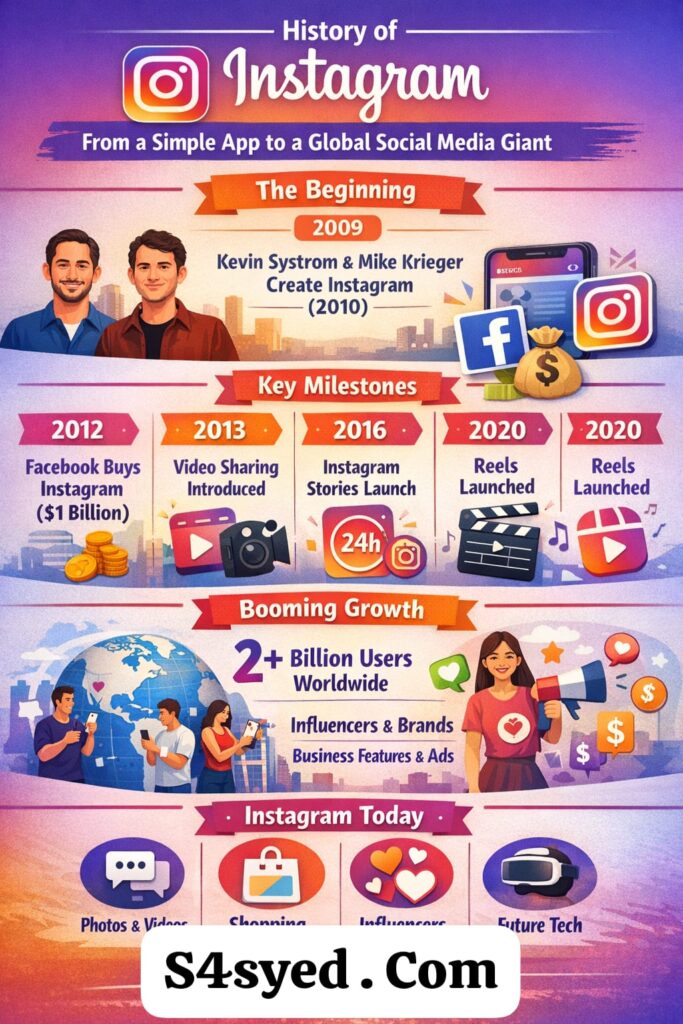
The story of Instagram began in 2009 when Kevin Systrom, a Stanford University graduate, was working on a mobile application called Burbn. Burbn was a location-based app that allowed users to check in at places, make plans, and share photos. However, the app was too complicated and had many unused features.
Kevin noticed that users were most interested in sharing photos. Around the same time, Mike Krieger, another Stanford graduate and software engineer, joined Kevin. Together, they decided to simplify the app and focus only on photo sharing.
This decision became the foundation of Instagram.
Birth of Instagram (2010)
Instagram was officially launched on October 6, 2010, for iOS (iPhone) users. The name Instagram comes from a combination of two words:
Instant (quick sharing)
Telegram (communication)
The app allowed users to:
Take photos
Apply filters
Share images instantly with followers
One of Instagram’s biggest early strengths was its photo filters, which made simple photos look artistic and professional.
Instant Success
Instagram became an overnight success. Within:
24 hours → 25,000 users
1 week → 100,000 users
2 months → 1 million users
This rapid growth surprised even its founders.
Expansion and Growth (2011–2012)
New Features
In 2011, Instagram added:
Hashtags to help users discover content
Improved filters
Explore page for trending photos
Android Launch (2012)
In April 2012, Instagram launched its Android version, opening the platform to millions of new users worldwide. On the first day alone, it received over 1 million downloads.
Facebook Acquires Instagram (2012)
One of the biggest moments in Instagram’s history came in April 2012, when Facebook (now Meta) acquired Instagram for approximately $1 billion in cash and stock.
At that time:
Instagram had only 13 employees
Over 30 million users
No major revenue system
Why Facebook Bought Instagram
Facebook saw Instagram as:
A fast-growing competitor
A powerful mobile photo-sharing platform
A future leader in social networking
Mark Zuckerberg promised to keep Instagram independent while supporting its growth.
Introduction of Video and Advertising (2013–2015)
Video Sharing (2013)
In 2013, Instagram introduced 15-second video sharing, allowing users to upload short videos. This was a direct response to the popularity of video content.
Instagram Ads (2013)
Instagram also launched advertising, allowing businesses to promote their products. Initially, ads were limited, but later they became a major source of revenue.
Direct Messaging
Instagram introduced Direct Messages, enabling private conversations between users.
Stories Feature and Competition with Snapchat (2016)
In August 2016, Instagram launched one of its most successful features: Instagram Stories.
What Are Stories?
Photos or videos that disappear after 24 hours
Stickers, text, filters, and emojis
Live videos
This feature was inspired by Snapchat, but Instagram Stories quickly became more popular due to Instagram’s large user base.
Reels, IGTV, and Video Evolution (2018–2022)
IGTV (2018)
lounch
Instagram launched IGTV for long-form vertical videos. Although it had limited success, it showed Instagram’s focus on video content.
Reels (2020)
To compete with TikTok, Instagram introduced Reels, allowing users to create short, entertaining videos with music, effects, and trends.
Reels quickly became one of Instagram’s most engaging features.
Instagram Under Meta (Facebook Rebranding)
In 2021, Facebook rebranded itself as Meta, focusing on:
Virtual reality
Artificial intelligence
The metaverse
Instagram became a core part of Meta’s ecosystem, alongside Facebook and WhatsApp.
Business, Influencers, and Monetization
Instagram transformed how people earn money online.
Influencer Marketing
Brands collaborate with influencers
Sponsored posts
Affiliate marketing
Business Tools
Instagram introduced:
Business profiles
Insights and analytics
Shopping features
Product tagging
Small businesses and creators began using Instagram as a full-time income source.
Security, Privacy, and Mental Health Concerns
As Instagram grew, it also faced criticism related to:
Data privacy
Fake accounts
Cyberbullying
Mental health effects on teenagers
Instagram responded by adding:
Privacy controls
Comment filtering
Hidden likes option
Time-management tools
Instagram Today
Today, Instagram has:
Over 2 billion monthly active users
Users from almost every country
Content in photos, videos, stories, and live streams
It is used for:
Personal communication
News and trends
Business marketing
Education
Entertainment
Impact of Instagram on Society
Instagram has changed:
How people share memories
How businesses market products
How trends go viral
How influencers shape opinions
It has created new careers, including:
Content creators
Social media managers
Digital marketers
Future of Instagram
The future of Instagram includes:
More AI-powered tools
Enhanced video features
Creator monetization
Integration with the metaverse
Improved safety and privacy
Instagram continues to evolve with technology and user needs.
Conclusion
Instagram’s journey from a simple photo-sharing app to a global social media powerhouse is truly remarkable. Founded in 2010 by Kevin Systrom and Mike Krieger, Instagram revolutionized visual communication. With continuous innovation, strategic decisions, and global reach, Instagram remains one of the most influential platforms in the digital world.
Whether used for fun, business, or creativity, Instagram has become an essential part of modern life—and its story is still be

Leave a Reply