
Introduction
UC Browser is a mobile and desktop web browser that became especially popular in Asia, Africa, and parts of the Middle East during the early 2010s. Known for its fast browsing experience, aggressive data compression technology, and suitability for low-end devices and slow internet connections, UC Browser played a significant role in bringing the internet to millions of first-time users. Developed by UCWeb, a subsidiary of the Chinese technology giant Alibaba Group, UC Browser’s journey reflects the broader evolution of mobile internet usage in emerging markets
.ntroduction covering its origins,
This Introduction covering its origins, technological innovations, global expansion, peak popularity, challenges, controversies, and its current status in the global browser ecosystem.
(2004–2006)
UC Browser traces its roots back to 2004 in Guangzhou, China. It was developed by UCWeb (formerly called UC Mobile), a company founded by He Xiaoyi (also known as Jack He) and Liang Jie. At the time, internet access on mobile phones was extremely limited. Most devices had small screens, weak processors, and relied on slow 2G networks. Existing browsers were either unavailable or poorly optimized for mobile use.
UCWeb initially focused on building
UCWeb initially focused on building a browser based on Java (J2ME) for feature phones rather than smartphones, which were still rare and expensive. The goal was simple but ambitious: to make web browsing faster, cheaper, and more accessible on mobile devices. The first versions of UC Browser used a cloud-based architecture, where web pages were fetched and compressed on remote servers before being delivered to users’ devices. This approach significantly reduced data usage and loading times.
In 2006
In 2006, UC Browser was officially released to the public in China. It quickly gained attention among mobile users who were frustrated with slow and unreliable browsing experiences.
History (2006–2009)
Between 2006 and 2009, UC Browser experienced rapid growth within China. During this period, China saw a massive increase in mobile phone usage, especially among young users and urban populations. Feature phones dominated the market, and UC Browser’s lightweight design made it ideal for such devices.
Key factors behind its early success included:
Data compression technology, which reduced data costs
Support for a wide range of devices, including Nokia, Samsung, Sony Ericsson, and Motorola phones
Customizable user interface, allowing users to adjust fonts and layouts
Download manager, which supported resumable downloads
By 2009, UC Browser had become one of the most popular mobile browsers in China, competing directly with Opera Mini, another browser known for data compression.
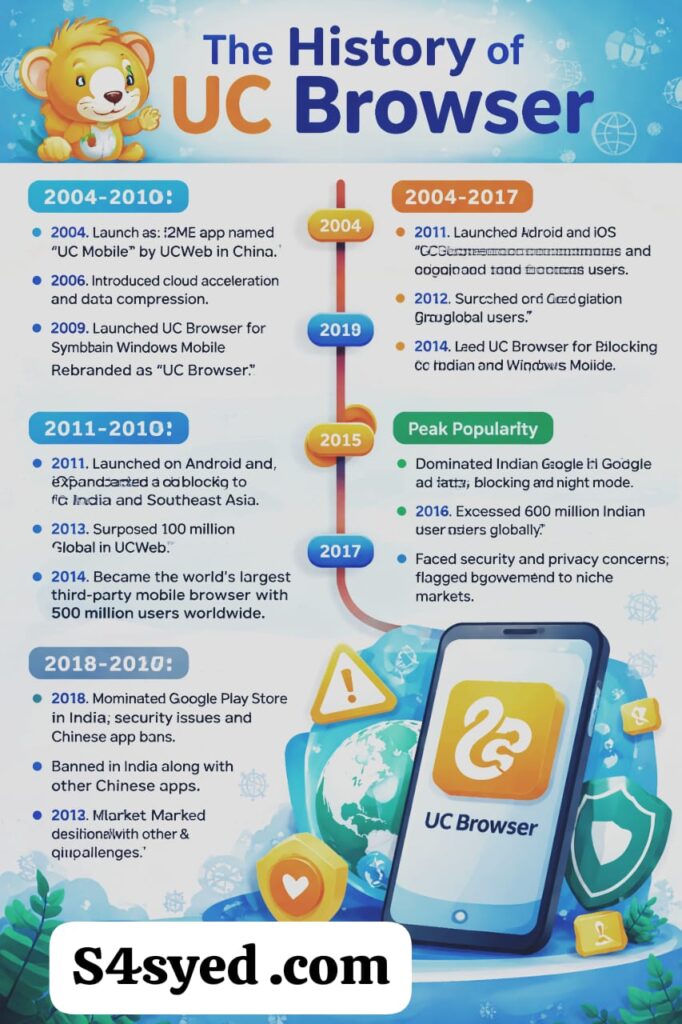
(2009–2013)
After establishing a strong position in China, UCWeb began expanding internationally around 2009. The company identified emerging markets—such as India, Indonesia, Pakistan, Bangladesh, Nigeria, and other African countries—where mobile internet usage was growing rapidly but infrastructure remained weak.
Entry into India
India became UC Browser’s most important international market. Low-cost Android smartphones and expensive mobile data plans created the perfect conditions for UC Browser’s compression-based browsing model. UC Browser was localized into multiple Indian languages, including Hindi, Tamil, Telugu, and Bengali, which helped it reach non-English-speaking users.
By 2013, UC Browser had become the number one mobile browser in India, surpassing Google Chrome in market share on mobile devices.
Popularity in Southeast Asia and Africa
UC Browser also gained significant traction in countries such as Indonesia, Vietnam, Thailand, and Nigeria. Its ability to work smoothly on entry-level Android phones made it a favorite among students and first-time internet users.
Acquisition by Alibaba Group (2014)
A major milestone in UC Browser’s history came in 2014 when Alibaba Group acquired UCWeb. Although Alibaba had already invested in UCWeb earlier, this acquisition integrated UC Browser fully into Alibaba’s ecosystem.
The acquisition provided UCWeb with:
Greater financial resources
Access to Alibaba’s advertising and e-commerce platforms
Improved cloud infrastructure
Stronger global expansion capabilities
Following the acquisition, UC Browser began to shift from being just a browser to a content and service platform. News feeds, short videos, games, and shopping links were integrated into the browser, especially in international versions.
Technological Innovations and Features
UC Browser distinguished itself through several key technologies and features:
Cloud Acceleration and Data Compression
UC Browser’s servers compressed web pages before sending them to users, reducing data consumption by up to 90% in some cases. This feature was crucial in regions with expensive or slow internet.
Fast Download Manager
The built-in download manager supported multiple file formats and allowed users to pause and resume downloads, a rare feature on early mobile browsers.
Video Streaming Optimization
UC Browser optimized video playback for slow networks and introduced features like background downloading and adjustable video quality.
UC News and Content Platform
The browser included a personalized news feed powered by algorithms, similar to other content aggregation platforms. This increased user engagement but also shifted the browser’s focus away from pure web navigation.
Peak Popularity and Market Leadership (2014–2017)
Between 2014 and 2017, UC Browser reached its peak global popularity. It consistently ranked among the top three mobile browsers worldwide by active users. In some regions, it held over 40% market share.
During this period:
UC Browser reported hundreds of millions of monthly active users
It became the default browser on many low-cost Android devices
The brand invested heavily in marketing, sponsorships, and celebrity endorsements, especially in India
UC Browser was no longer just a utility—it had become a major gateway to the internet for millions of people.
Challenges and Security Concerns (2018–2019)
Despite its success, UC Browser began facing increasing challenges.
Privacy and Data Security Issues
Security researchers raised concerns about:
Insecure data transmission
Weak encryption practices
Potential exposure of user data
These concerns damaged the browser’s reputation, especially among more privacy-conscious users.
Content Moderation Criticism
UC Browser’s news platform was criticized for spreading misleading, sensational, or inappropriate content. Governments and media organizations in several countries raised concerns about misinformation.
Ban in India and Decline (2020)
In June 2020, the Government of India banned UC Browser along with several other Chinese apps, citing national security and data privacy concerns. This decision had a massive impact on UC Browser, as India was its largest market outside China.
The ban resulted in:
Loss of tens of millions of users
Removal from Google Play Store and Apple App Store in India
Decline in advertising revenue
Similar restrictions and reduced popularity followed in other regions as users migrated to Google Chrome, Firefox, and newer lightweight browsers.
Current Status and Legacy
As of the early 2020s, UC Browser is no longer as dominant as it once was, but it continues to operate in selected markets. The company has shifted focus toward content services, enterprise solutions, and regional partnerships.
Despite its decline, UC Browser’s legacy remains significant:
It helped democratize internet access in developing countries
It set standards for data compression and cloud-based browsing
It influenced the design of many lightweight browsers
For millions of users, UC Browser was their first experience of the internet.
Conclusion
The history of UC Browser is closely tied to the rise of mobile internet in emerging markets. From its humble beginnings as a Java-based browser for feature phones to becoming a global leader in mobile browsing, UC Browser transformed how people accessed the web under limited conditions.
While security concerns, competition, and geopolitical factors contributed to its decline, UC Browser remains an important chapter in the history of mobile technology. Its story highlights how innovation tailored to local needs can achieve massive global impact, even in a highly competitive industry.
