Introduction
VidMate is a widely known multimedia application primarily recognized for enabling users to download videos, music, and other media content from a variety of online platforms. Over the years, VidMate has become especially popular in regions where users seek offline access to online videos due to limited or expensive internet connectivity. Although it has also attracted controversy because of copyright and platform policy concerns, VidMate’s growth reflects broader trends in mobile internet usage, content consumption, and the demand for flexible media access. This document presents a detailed historical overview of VidMate, tracing its origins, development, features, challenges, and impact on the digital ecosystem.
Background: The Rise of Mobile Video Consumption
To understand the emergence of VidMate, it is important to consider the broader technological and social context of the early 2010s. The rapid global adoption of smartphones, particularly Android devices, transformed how people accessed the internet. In many developing markets across Asia, Africa, and parts of Latin America, Android phones became the primary gateway to digital content.
At the same time, platforms such as YouTube, Facebook, Dailymotion, and later Instagram and TikTok, experienced explosive growth in video sharing and streaming. However, consistent high-speed internet access was not always available. Users often faced slow connections, limited data plans, or high costs. As a result, there was strong demand for applications that allowed users to download content for offline viewing. VidMate emerged as a response to this demand.
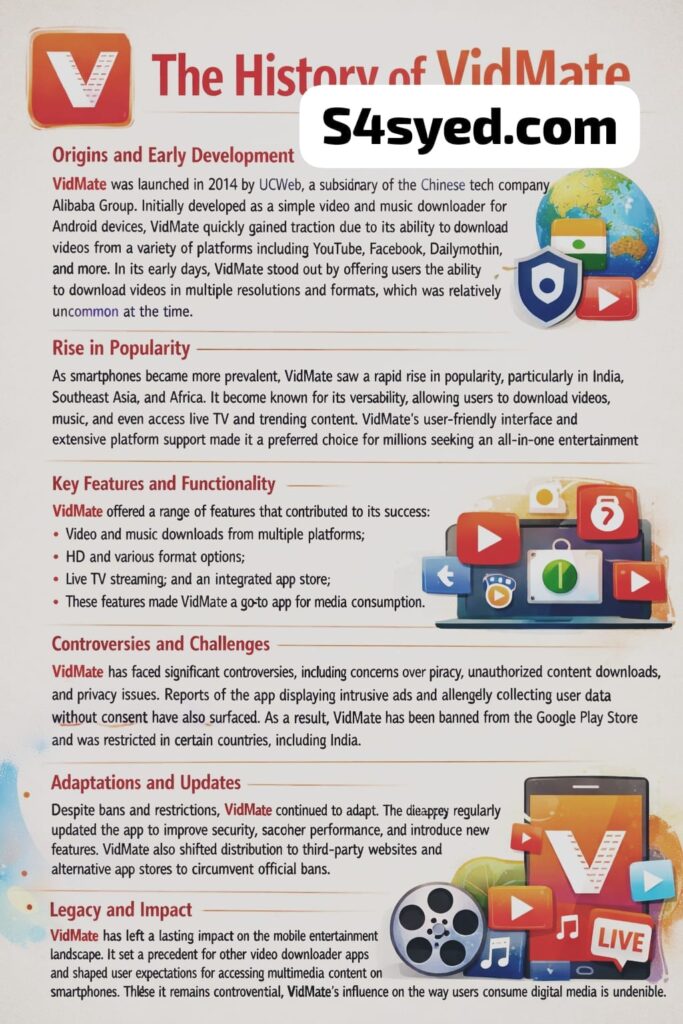
Origins and Early Development
VidMate is believed to have been launched in the early-to-mid 2010s as an Android-based application. From its inception, the app focused on simplicity and practicality. Unlike many official streaming apps, VidMate emphasized direct downloading rather than streaming alone. Users could search for videos within the app or paste links from supported platforms and then choose download formats and resolutions.
One notable aspect of VidMate’s early development was its decision not to rely on official app distribution channels. The application was not made available on the Google Play Store, largely because its core functionality conflicted with Google’s policies regarding the downloading of content from platforms like YouTube. Instead, VidMate was distributed through its own website and third-party app stores, a strategy that allowed it to bypass certain restrictions while still reaching millions of users.
Expansion of Features
As VidMate gained popularity, its developers expanded its feature set to appeal to a broader audience. Initially focused on video downloads, the app gradually introduced support for:
Multiple video resolutions, ranging from low-quality formats suitable for basic phones to high-definition (HD) options.
Audio extraction, allowing users to download only the audio portion of videos in formats such as MP3.
Support for a wide range of websites, including social media platforms, video hosting services, and music sites.
An in-app search engine and content discovery interface, enabling users to browse trending videos, movies, and songs.
These features made VidMate more than just a downloader; it became a comprehensive media hub for many users.
User Interface and Localization
A key factor in VidMate’s success was its focus on user-friendly design and localization. The interface was designed to be intuitive, even for users with limited technical knowledge. Large icons, clear download buttons, and straightforward menus contributed to its accessibility.
Additionally, VidMate invested in regional content and language support. In countries such as India, Pakistan, Bangladesh, and Indonesia, the app highlighted local movies, music, and television content. This localization strategy helped VidMate compete with global platforms by offering culturally relevant material.
Popularity in Emerging Markets
VidMate’s growth was particularly strong in emerging markets. Several factors contributed to this popularity:
- Offline Access: Downloaded content could be watched without an internet connection, saving data costs.
- Flexible Formats: Users could choose smaller file sizes to match their storage and bandwidth limitations.
- Broad Platform Support: VidMate supported many websites that did not offer official download options.
In regions where internet infrastructure was still developing, these advantages made VidMate an essential tool for digital entertainment.
Controversies and Legal Challenges
Despite its popularity, VidMate has faced significant controversy. Many content platforms prohibit downloading because it can violate copyright laws and their terms of service. As a result, VidMate has often been criticized by copyright holders and technology companies.
Google’s policies explicitly restrict apps that enable downloading from YouTube, which explains why VidMate has never been officially listed on the Play Store. Security researchers and media outlets have also occasionally raised concerns about the safety of third-party app stores, warning users about potential malware risks, although VidMate’s developers have generally denied such claims.
In some countries, internet service providers and governments have attempted to restrict access to similar downloading applications as part of broader anti-piracy efforts. These challenges have forced VidMate to frequently update its infrastructure and distribution methods.
Business Model and Monetization
VidMate’s monetization strategy has primarily relied on in-app advertising. Because the app is free to download and use, advertisements serve as the main revenue source. These ads appear within the app interface, including banner ads and occasional full-screen promotions.
The developers have also partnered with content aggregators and advertisers targeting specific regional markets. While VidMate does not charge subscription fees, its large user base makes it attractive to advertisers seeking visibility in mobile-first economies.
Technological Evolution
Over time, VidMate has adapted to changes in Android operating systems and online platforms. Frequent updates have been necessary to maintain compatibility with websites that regularly change their code to prevent downloading. This ongoing technical challenge has been a defining aspect of VidMate’s development.
The app has also improved download management features, such as pause-and-resume functionality, batch downloads, and background downloading. These enhancements reflect user feedback and the increasing sophistication of mobile users.
Competition and Alternatives
VidMate operates in a highly competitive environment are very high . Numerous other video downloading applications and services offer similar features. Some focus on specific platforms, while others aim to provide all-in-one solutions.
At the same time, official streaming services have expanded their own offline viewing options. Platforms like YouTube, Netflix, and Amazon Prime Video now allow limited downloads within their apps, reducing the need for third-party solutions. However, these official options often come with restrictions, such as expiration dates and regional limitations, which continue to drive interest in apps like VidMate.
Cultural and Social Impact
VidMate has had a noticeable cultural impact in certain regions. By enabling easy access to movies, music, and viral videos, it has influenced how people share and consume media. In some communities, downloaded videos are shared offline via Bluetooth or local file-sharing apps, extending VidMate’s reach beyond individual devices.
For independent creators and small production houses, VidMate has been a double-edged sword. While it can increase visibility, it can also reduce potential revenue by facilitating unauthorized distribution.
Current Status and Ongoing Relevance
As of the mid-2020s, VidMate remains active and continues to release updates. Its user base, while facing increasing competition from official platforms, remains substantial. The app’s continued relevance highlights ongoing tensions between user convenience, copyright enforcement, and platform control.
VidMate’s history demonstrates how technological solutions often emerge to fill gaps left by official services. Even as internet access improves globally, the desire for control over digital content ensures that applications like VidMate continue to attract attention.
Conclusion
The history of VidMate is closely tied to the evolution of mobile internet usage and digital media consumption. From its origins as a simple video downloader to its growth into a multifunctional media application, VidMate has reflected the needs and preferences of millions of users worldwide. While controversies and legal challenges have shaped its path, the app’s persistence underscores the demand for flexible, offline access to online content.
Ultimately, VidMate represents both the opportunities and challenges of the digital age. Its story is not just about a single application, but about how technology, users, and content providers interact in an increasingly connected world.
