
INTRODECTION
- Origins and Founding (2009)
WhatsApp was founded by two American software engineers, Jan Koum and Brian Acton, in 2009. Both men had previously worked at Yahoo! and became friends there. After leaving Yahoo! in 2007, Koum came up with the idea of WhatsApp in early 2009 as a simple status‑sharing app — a place where people could display how they were feeling or what they were doing so others could see it, instead of having to text everyone individually. �
Encyclopedia Britannica +1
Koum actually registered the company name “WhatsApp” on February 24, 2009 — the very day that is often celebrated as WhatsApp’s birthday. The name itself is a pun on the English phrase “What’s up?”, which is a casual greeting. �
WIRED
At first, the app did very little. When it first appeared on the Apple App Store, it was simply a way people could list their status message — for example, “Available”, “Busy”, or “At Work”. The idea didn’t catch on immediately.
However, when Apple introduced push notifications on iOS later in 2009, Koum and Acton realized they could reframe WhatsApp into a messaging app. Instead of just showing a status, the app could use notifications to deliver messages. Inspired partly by their own frustrations with remembering usernames and passwords, they wanted something that would just work — with no usernames, no complicated logins, and no ads. �
WIRED
To make things easier, WhatsApp decided to authenticate users using their phone numbers, rather than usernames. This simple idea turned out to be revolutionary because it automatically connected a person’s contact list to the app — which meant you could instantly see who else in your phonebook was using WhatsApp. - Early Growth and Features (2010–2013)
By 2010 and 2011, WhatsApp became much more than just a status app. Even though there were other messaging platforms already — such as SMS (texting), email, and chat apps like BlackBerry Messenger — WhatsApp’s cross‑platform compatibility (iPhone and Android) and ease of use helped it catch on fast.
Encyclopedia Britannica
The company raised $250,000 in initial funding from friends and early supporters, which gave them the resources to keep building faster. Soon after, WhatsApp introduced new features such as:
Photo and media sharing — way before many platforms offered easy picture messaging.
Voice messaging — recorded voice messages that could be sent instantly.
Group chats — a key feature that would later become one of WhatsApp’s most widely used tools.
Encyclopedia Britannica
In 2011, Sequoia Capital — a well‑known venture capital firm — invested $8 million in WhatsApp, marking the beginning of serious growth. A year later, in 2013, Sequoia invested another $50 million as the app crossed 200 million users.
Encyclopedia Britannica
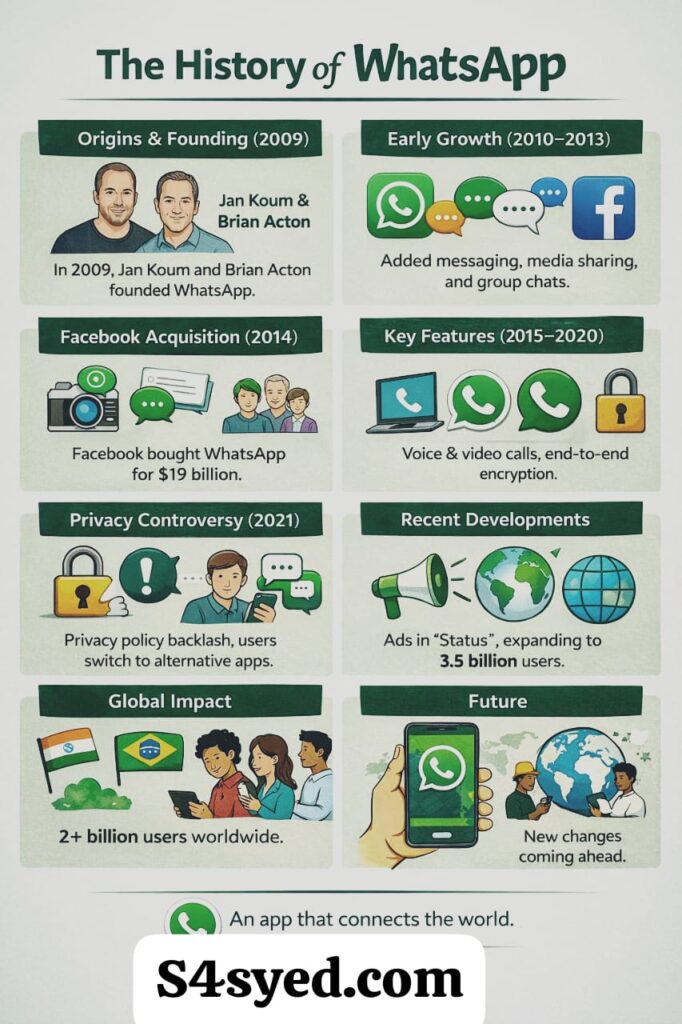
- One of the reasons for this rapid adoption was that WhatsApp worked internationally, not just in the United States. In countries where SMS texting was expensive — such as India, Brazil, and many parts of Africa — WhatsApp provided a free or low‑cost alternative. This global reach set it apart from many competitors.
- Scaling and Business Model
From almost the very beginning, WhatsApp took a unique stance: no ads, and very minimal data collection. Koum and Acton believed privacy was important; they did not want to sell user data to advertisers the way many social platforms do. Early on, the app was free to download for the first year and then charged a small annual fee of $0.99, which helped cover costs without selling ads.
WIRED
This simplicity was appealing to users but also meant the company had to grow carefully to keep its infrastructure stable as traffic grew. Their philosophy was “No Ads, No Games, No Gimmicks” — and this became a slogan the founders repeated often.
WIRED - The Facebook Acquisition (2014)
By 2014, WhatsApp had exploded in popularity, with hundreds of millions of active users. That year it attracted the attention of Facebook, which was looking to expand beyond its social network and into global messaging.
On February 19, 2014, Facebook announced that it would acquire WhatsApp for about $19 billion — one of the largest tech acquisitions in history. The deal included cash, Facebook shares, and restricted stock units for the founders and employees.
about.fb.com
This acquisition was significant for several reasons:
It showed how important messaging had become in global communication.
It was a huge financial event; Facebook paid far more for WhatsApp than most other acquisitions in tech.
It raised questions about privacy and independence because WhatsApp had always promised minimal data collection and a separate identity from Facebook.
about.fb.com
Despite being bought by Facebook, WhatsApp continued to operate relatively independently for some time. The founders remained part of the leadership, and WhatsApp did not introduce ads right away. But over time, Facebook’s influence grew in the app’s strategy. - Key Feature Additions (2015–2020)
After the acquisition, WhatsApp continued adding major features.
WhatsApp Web (2015) — This allowed users to access their chats from a desktop or laptop browser while still linked to their phone.
Capital Commerce – Tech Consulting Group
Voice and Video Calling (2016) — WhatsApp added the ability to make voice calls and later video calls, turning it into not just a text service but a full communication platform.
Encyclopedia Britannica
End‑to‑End Encryption (2014–2016) — One of the biggest milestones was the rollout of encryption that made every message and call only readable by the sender and recipient, not even by WhatsApp itself. This used technology developed with Open Whisper Systems (now Signal Foundation) and became one of the largest deployments of end‑to‑end encryption in the world.
WIRED
Group Voice and Video Calls — WhatsApp expanded its calling features to include group calls, making it popular for families and small teams during the COVID‑19 pandemic.
Wikipedia
Business Features — WhatsApp Business was introduced to let companies communicate with customers, share catalogs, and provide support directly in chat.
Payment Features — In some countries, WhatsApp added peer‑to‑peer payment options, allowing users to send money within their chats.
Status Updates — Similar to temporary stories on Instagram or Snapchat, status updates let people share short photos or text that disappear after 24 hours.
Throughout this period, WhatsApp continued to grow rapidly. By 2016, it had reached 1 billion monthly users, and by 2020 and beyond, it had more than 2 billion — making it the most widely used messaging app in the world by a large margin.
Encyclopedia Britannica +1 - Privacy Controversies and Public Backlash
Despite its popularity, WhatsApp has faced significant criticism — especially after the Facebook acquisition.
In 2016 and later, WhatsApp changed its terms of service to share more metadata (like phone numbers or usage stats) with Facebook for business and advertising purposes. This alarmed many users who had chosen WhatsApp because of its privacy stance.
Encyclopedia Britannica
In 2021, WhatsApp announced a controversial update to its privacy policy that would require users to agree to share certain data with Facebook. This led many users to switch to alternative apps like Signal and Telegram, a movement widely called the social migration wave.
Wikipedia
WhatsApp has also been implicated in several scandals:
Pegasus spyware incident (2019) — Spyware developed by the NSO Group was used to target journalists, activists, and officials through a loophole in WhatsApp. The company filed a lawsuit and significantly patched the issue, but it highlighted vulnerabilities in security.
Wikipedia +1
Misinformation spread — Because messages are encrypted and private, it’s hard for WhatsApp to monitor or stop false information from spreading through group chats, especially in countries like India and Brazil. This has been linked to real‑world violence and rumour campaigns.
The Guardian
Governments in some countries have even temporarily restricted or blocked WhatsApp during protests or unrest, trying to limit rapid communication. - Recent Developments (2020s and Beyond)
In recent years, WhatsApp has continued evolving:
Major design updates — WhatsApp began testing new interfaces like Apple’s “Liquid Glass” design for iOS apps.
The Times of India
Ad placements — In 2025, WhatsApp announced that it would begin showing advertisements in the “Status/Updates” section, a controversial move because the platform had long resisted ads.
Encyclopedia Britannica
Expansion of user base — New research suggests WhatsApp might have as many as 3.5 billion accounts by 2025, although the number of active users may differ from total accounts.
arXiv
Despite these changes, many users still rely on WhatsApp as their main method of communication — for personal chat, family calls, groups, business messages, and even government notifications. - WhatsApp’s Global Impact
WhatsApp’s story is one of transformation:
From a small status‑sharing idea in 2009, it became a global messaging powerhouse used in over 180 countries — including India, Brazil, Pakistan, and many parts of Africa and Europe. Its ease of use and low cost redefined communication in places where SMS and calls were expensive.
Encyclopedia Britannica
Unlike traditional social media platforms, WhatsApp doesn’t publicly display profiles or timelines — it is private and direct communication. This has made it essential for:
Everyday personal conversations
Business communications
Education groups
Political mobilization
Community organisation
However, this privacy has also made combating misinformation harder and raised questions about how big platforms should balance free communication with public safety.
