
History of CapCut
Introduction
CapCut is a widely used video editing application known for making professional-style video creation accessible to everyday users. Designed primarily for short-form video content, CapCut has become especially popular among social media creators, students, marketers, and small businesses. Its rise is closely connected with the global growth of short-video platforms and mobile-first creativity. This document explores the history of CapCut, from its origins and development to its global expansion, key features, and cultural impact.
Background: The Rise of Short-Form Video
Before understanding CapCut’s history, it is important to look at the broader context of digital media. During the late 2010s, short-form video content grew rapidly due to faster mobile internet, affordable smartphones, and social media platforms that prioritized video. Apps such as TikTok, Instagram, and YouTube Shorts changed how people consumed content, favoring short, engaging, and visually dynamic videos.
Many users wanted easy-to-use tools that could help them edit videos quickly without requiring professional skills. Traditional desktop editing software was powerful but complex and expensive. This gap in the market created an opportunity for mobile-based, beginner-friendly editing applications.
Creation and Launch
CapCut was developed by ByteDance, a Chinese technology company best known for creating TikTok (called Douyin in China). ByteDance recognized that many TikTok users wanted a simple way to edit videos that matched the platform’s style and trends.
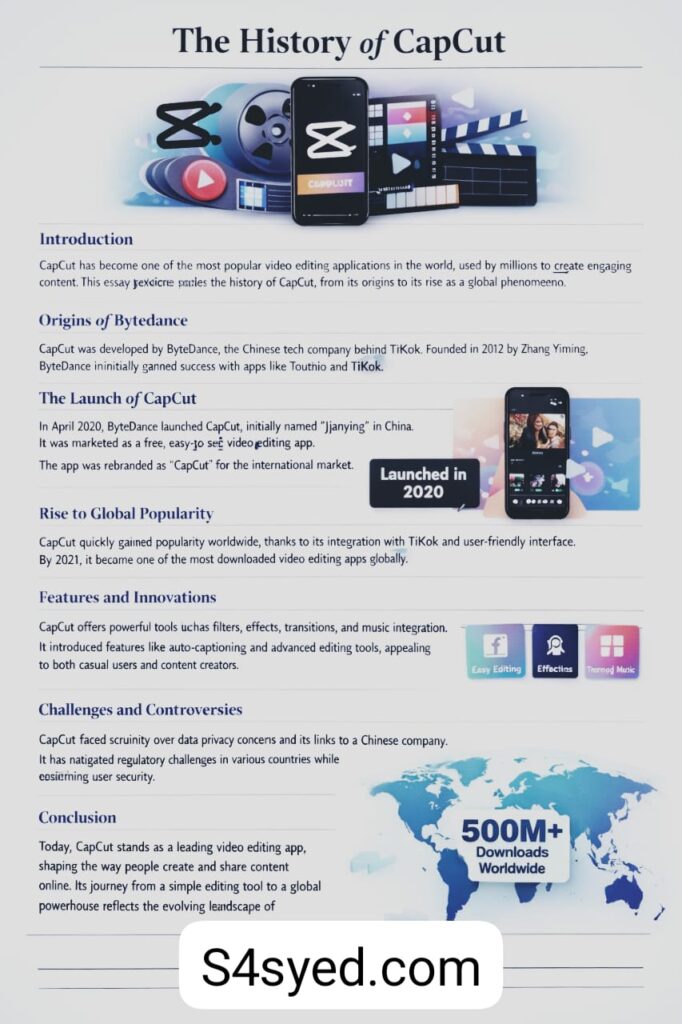
CapCut was first released in China under the name JianYing. The app focused on simplicity, offering ready-made templates, automatic effects, and an intuitive interface. Due to its success in the Chinese market, ByteDance later introduced the international version under the name CapCut.
The global launch of CapCut took place around 2019–2020, aligning with the rapid international growth of TikTok. CapCut was made available for both Android and iOS devices, and later expanded to desktop platforms as well.
Early Development and Features
In its early stages, CapCut emphasized ease of use. Unlike professional editing tools that required timelines with multiple complex layers, CapCut offered a clean layout that beginners could understand quickly. Some of its early features included:
Basic trimming and cutting tools
Music and sound effect integration
Text and subtitle tools
Filters and transitions
Stickers and visual effects
One of CapCut’s key strengths was its ability to sync music automatically with video clips, which was especially useful for social media trends and challenges.
Connection with TikTok and you tube
A major factor in CapCut’s success was its close integration with TikTok. Users could easily export videos from CapCut directly to TikTok without losing quality or format. Many TikTok trends were built around CapCut templates, encouraging users to download and use the app.
Although CapCut is a separate application, its design and features are clearly optimized for TikTok-style content. This relationship helped CapCut grow rapidly as TikTok’s user base expanded worldwide.
Global Expansion and Popularity
As TikTok became one of the most downloaded apps globally, CapCut’s popularity increased alongside it. The app gained millions of users across Asia, Europe, the Americas, and Africa. One of the reasons for its global success was that CapCut was free to use and offered powerful features without watermarks, which was uncommon among free editing apps.
CapCut also supported multiple languages, making it accessible to non-English-speaking users. Regular updates introduced new effects, fonts, animations, and templates tailored to regional trends.
Introduction of Templates and AI Tools
A significant milestone in CapCut’s history was the introduction of templates. Templates allowed users to create professional-looking videos by simply adding their photos or clips. This feature greatly reduced the time and skill needed for editing and made the app popular among beginners.
Later, CapCut began incorporating artificial intelligence (AI) tools, such as:
Automatic caption generation
Background removal
Face and body effects
Smart filters and enhancements
These AI-driven features positioned CapCut as a modern, intelligent editing platform suitable for fast-paced content creation.
Expansion to Desktop Platforms
Originally designed as a mobile app, CapCut later expanded to desktop versions for Windows and macOS. This marked an important step in its evolution, allowing more advanced editing while still maintaining simplicity.
The desktop version included multi-layer timelines, keyboard shortcuts, and higher export quality, attracting more serious content creators while keeping the software beginner-friendly.
Role in Education and Small Businesses
Over time, CapCut began to be used beyond entertainment. Teachers and students used it for presentations, educational videos, and school projects. Small businesses and marketers used CapCut to create advertisements, product videos, and social media promotions without hiring professional editors.
Its free access and ease of learning made it a valuable tool in regions where expensive software was not affordable.
Cultural and Social Impact
CapCut has played a role in shaping modern digital culture. Viral trends, memes, and challenges often rely on CapCut effects or templates. The app has empowered individuals to express creativity, tell stories, and build online identities.
By lowering the technical barriers to video editing, CapCut has helped democratize content creation. Anyone with a smartphone can now produce visually appealing videos and share them with a global audience.
Competition and Market Position
CapCut competes with other video editing apps such as InShot, VN, Adobe Premiere Rush, and KineMaster. However, its strong connection to TikTok, frequent updates, and generous free features have helped it maintain a strong position in the market.
ByteDance continues to invest in CapCut’s development to ensure it remains competitive in a fast-changing digital environment.
Privacy and Controversies
Like other apps developed by large technology companies, CapCut has faced questions related to data privacy and security, especially because of its connection to ByteDance. Some governments and organizations have expressed concerns, although CapCut operates as a separate editing tool.
Despite these concerns, the app remains widely used, and ByteDance has stated that it follows data protection laws in different regions.
Recent Developments and Future Outlook
In recent years, CapCut has continued to evolve with more advanced features, including cloud storage, collaborative tools, and enhanced AI capabilities. The app is increasingly positioned not just as a mobile editor, but as a complete content creation platform.
Looking ahead, CapCut is expected to further integrate artificial intelligence, support longer-form content, and expand its professional tools while keeping the interface user-friendly.
Conclusion
The history of CapCut reflects the changing nature of digital media and content creation. From its beginnings as a simple mobile editing app to its current status as a global video editing platform, CapCut has transformed how people create and share videos.
By combining simplicity, powerful features, and accessibility, CapCut has become an essential tool for millions of users worldwide. Its journey demonstrates how technology can empower creativity and shape modern communication in the digital age.
